
Support Ticketing System
The Support Ticket System extension for Magento provides a clear and organized way to handle customer queries. The admin and registered customers create support requests directly from their panels using a simple form. Each request includes a subject, message, type, priority, and attachments.
The admin manages all requests from a central dashboard. Tickets are assigned to agents, priorities are set, and statuses are updated for better tracking. Tickets are also organized by type and store view. Internal notes help admins and agents communicate privately without showing messages to customers. Features like starred tickets, filters, trash, and restore options make management easier and more efficient.
Customers access the support section from their account area on the storefront. All requests stay in one place with complete details such as status, replies, assigned agent, and priority. Customers reply to messages, attach files, and track updates without confusion. Email notifications keep customers, admins, and agents informed at every stage, ensuring a smooth and consistent support experience.
Features
- Easy Ticket Creation: Admins and customers create tickets using a simple form with subject, message, type, store view, and attachments.
- Magento Scope-Based Settings: Apply ticket settings at Default, Website, Store, or Store View level for flexible support management.
- Support Admin Usergroup Setup: Select a specific admin user role to manage support tickets. Only users under this role act as agents.
- Agent Assignment and Reassignment: Admins assign or change agents directly from the ticket view for faster handling.
- Support Ticket Dashboard: View all tickets in one place with options to filter, star, delete, restore, and customize columns.
- Advanced Ticket Filters: Filter tickets by status, agent, store view, subject, customer, and more for quick access.
- Ticket Types Management: Create and manage ticket types like Order Issues, Shipping, or Refunds. Default types stay protected.
- Priority and Status Control: Admins and agents update ticket priority, status, and type directly from the chat screen.
- Internal Notes for Private Discussion: Admins and agents exchange private messages using internal notes. Customers do not see these messages.
- Attachments Support: Admins, agents, and customers attach multiple files while creating or replying to tickets.
- Star, Trash, and Restore Options: Mark important tickets as starred. Move tickets to trash and restore them anytime.
- Collaborators via CC Email: Admins, agents, and customers add CC emails to include others in the conversation.
- Agent Panel Access: Assigned agents view and reply to tickets from their own admin panel.
- Customer Storefront Ticket Panel: Customers create, view, and reply to tickets from their account section across different stores.
- Email Templates and Notifications: Use ready-made email templates for ticket creation, replies, assignments, and updates. Admins, agents, and customers receive email alerts for every key ticket action.
Overview of the Module
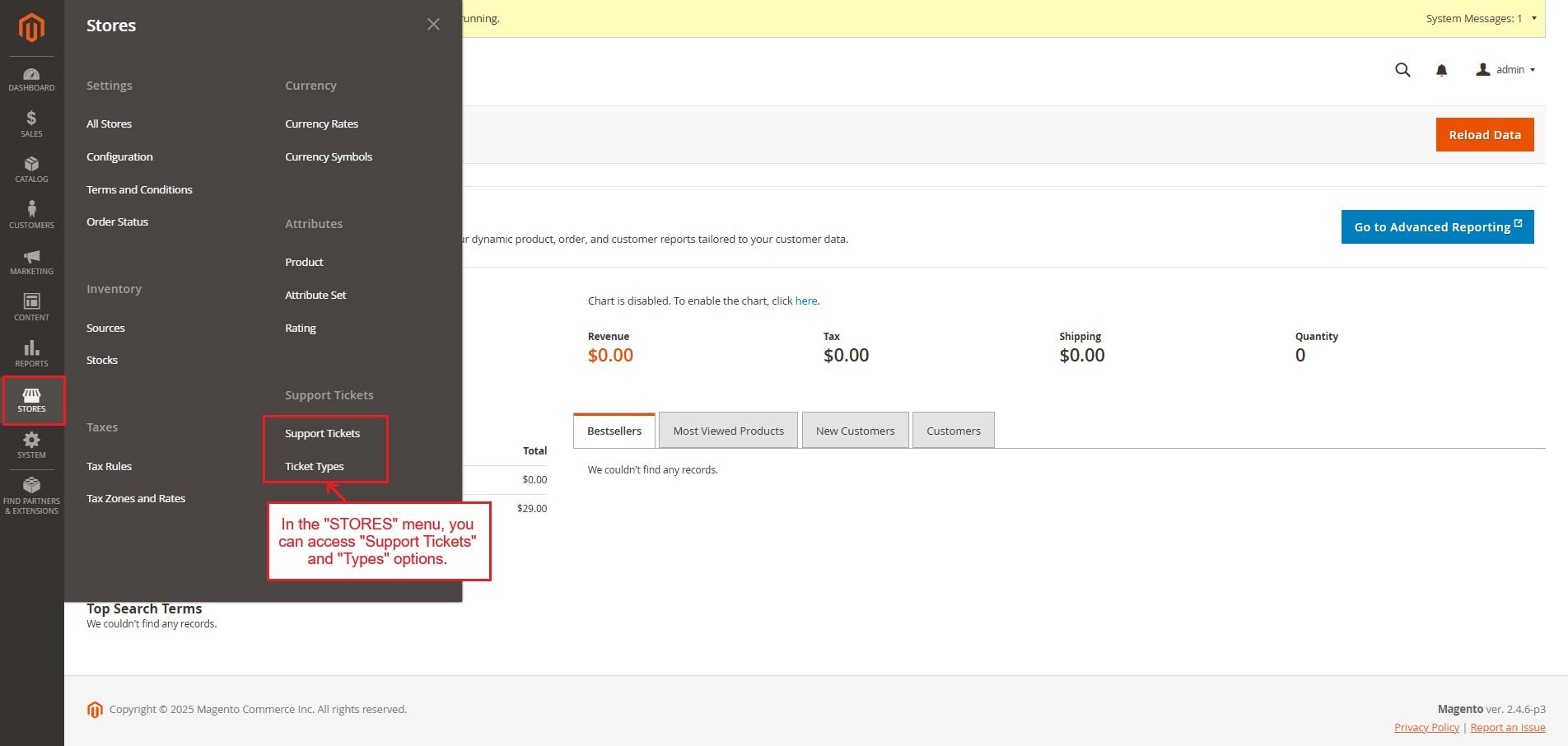
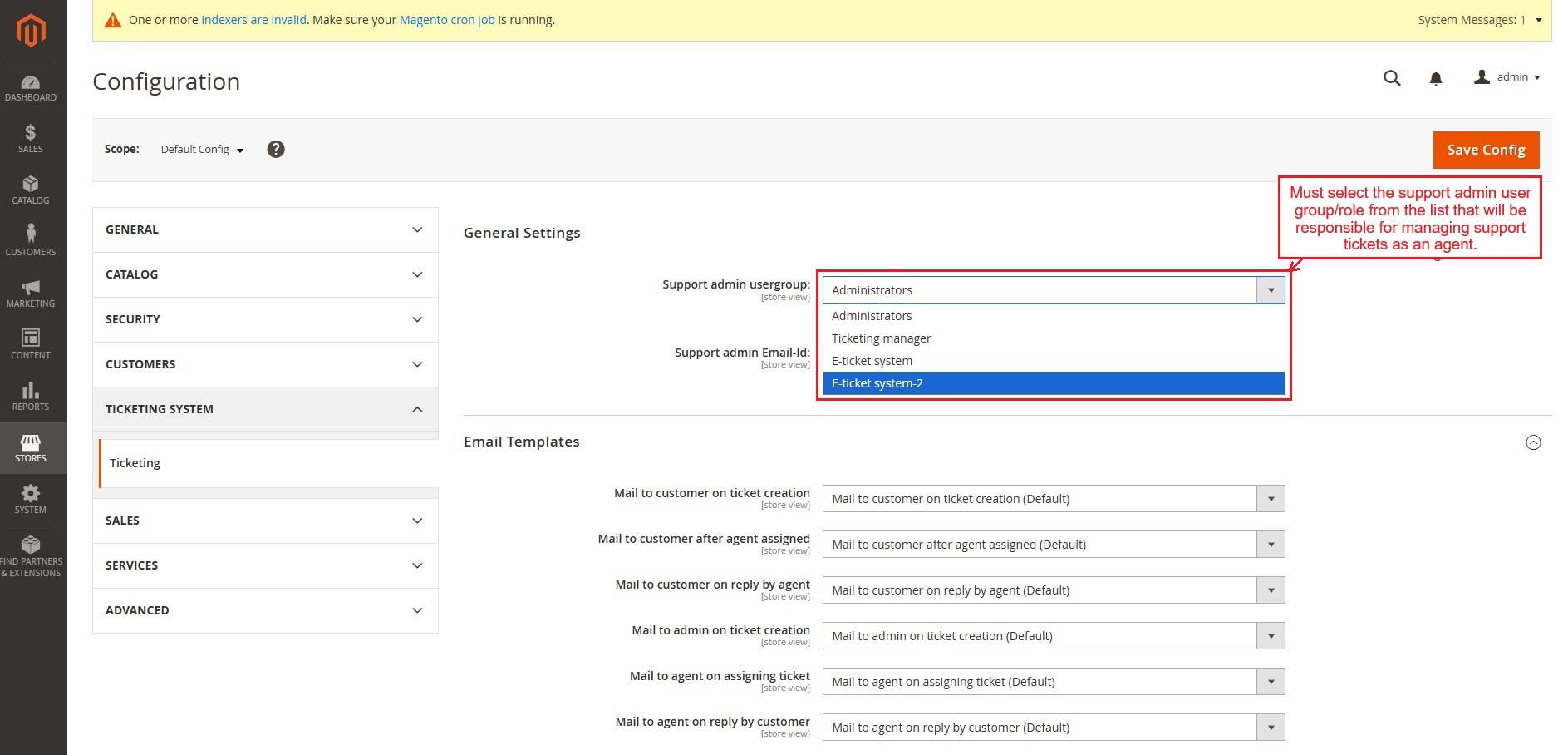
Go to the Stores menu and select the Configuration option to access the Module core settings.
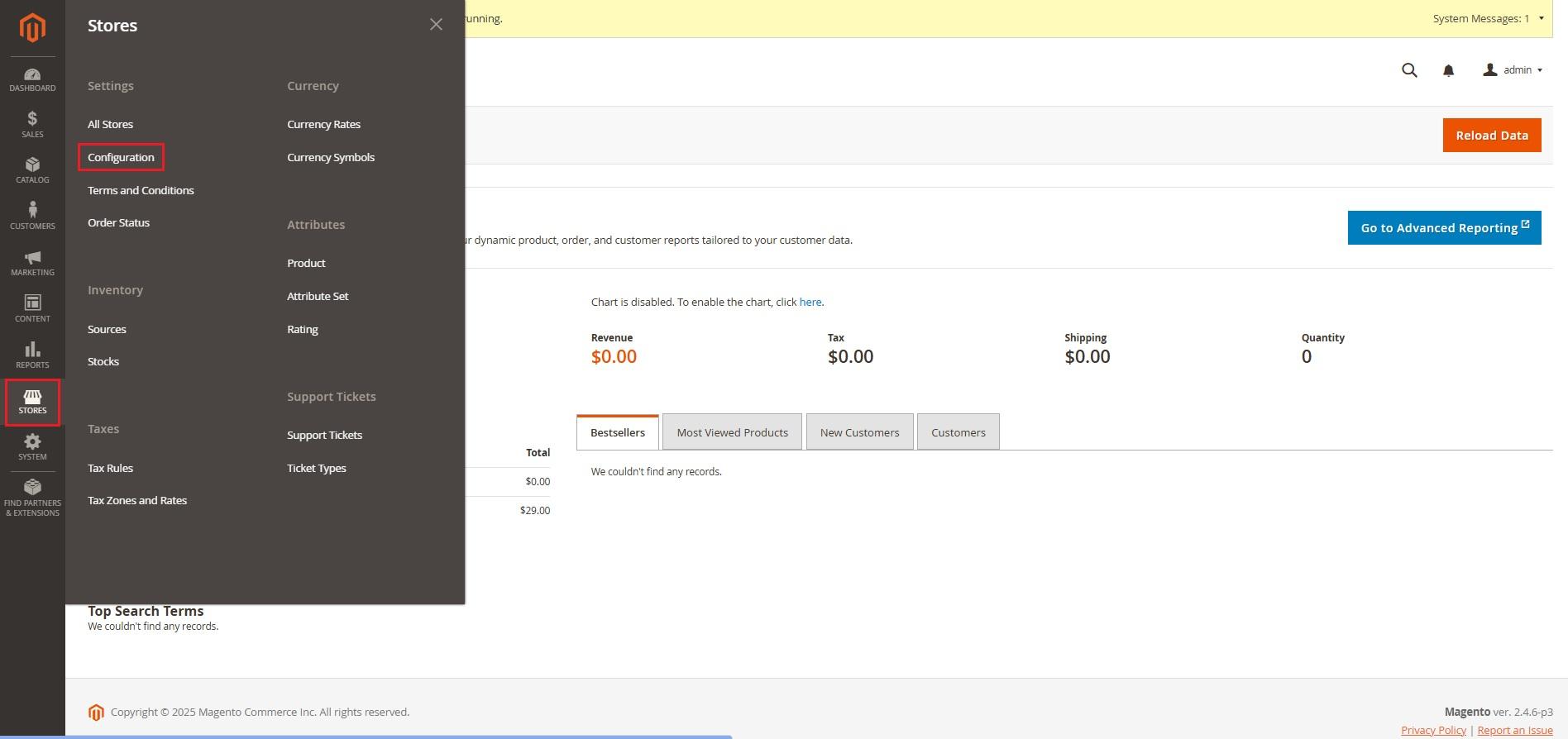
- Magento uses scopes to control where settings apply. Default Configuration applies to all websites and stores. Website, Store, and Store View apply to specific sites or languages. In this, Default Configuration is selected.
- Now you need to select the Ticketing System option and open “Ticketing”. Here, the “General Settings” page shows two main settings: Support Admin Usergroup and Support Admin Email ID.
- Support Admin Usergroup: Use the down arrow to select the support admin user group/role responsible for managing support tickets.
- Support Admin Email ID: In the field, enter the support admin email ID that will be used to receive and send ticket-related emails to customers.
- The Email Templates section provides ready-made formats for automatic emails. These emails are sent to customers, admins, and agents during important ticket events like ticket creation, agent assignment, or new replies.
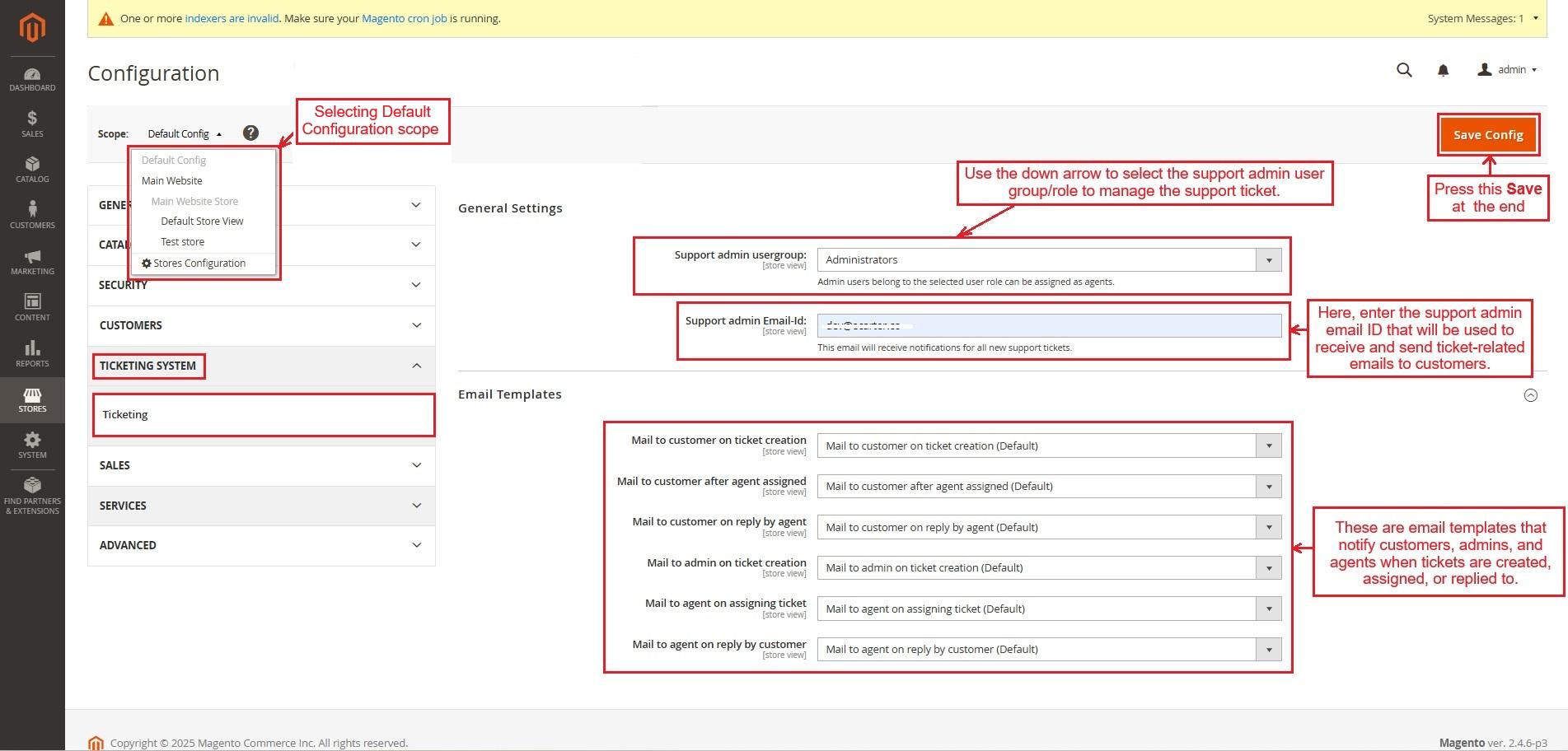
- In the "Stores" menu, you can access "Support Tickets" and "Types" options.
Manage Support Tickets with Ease
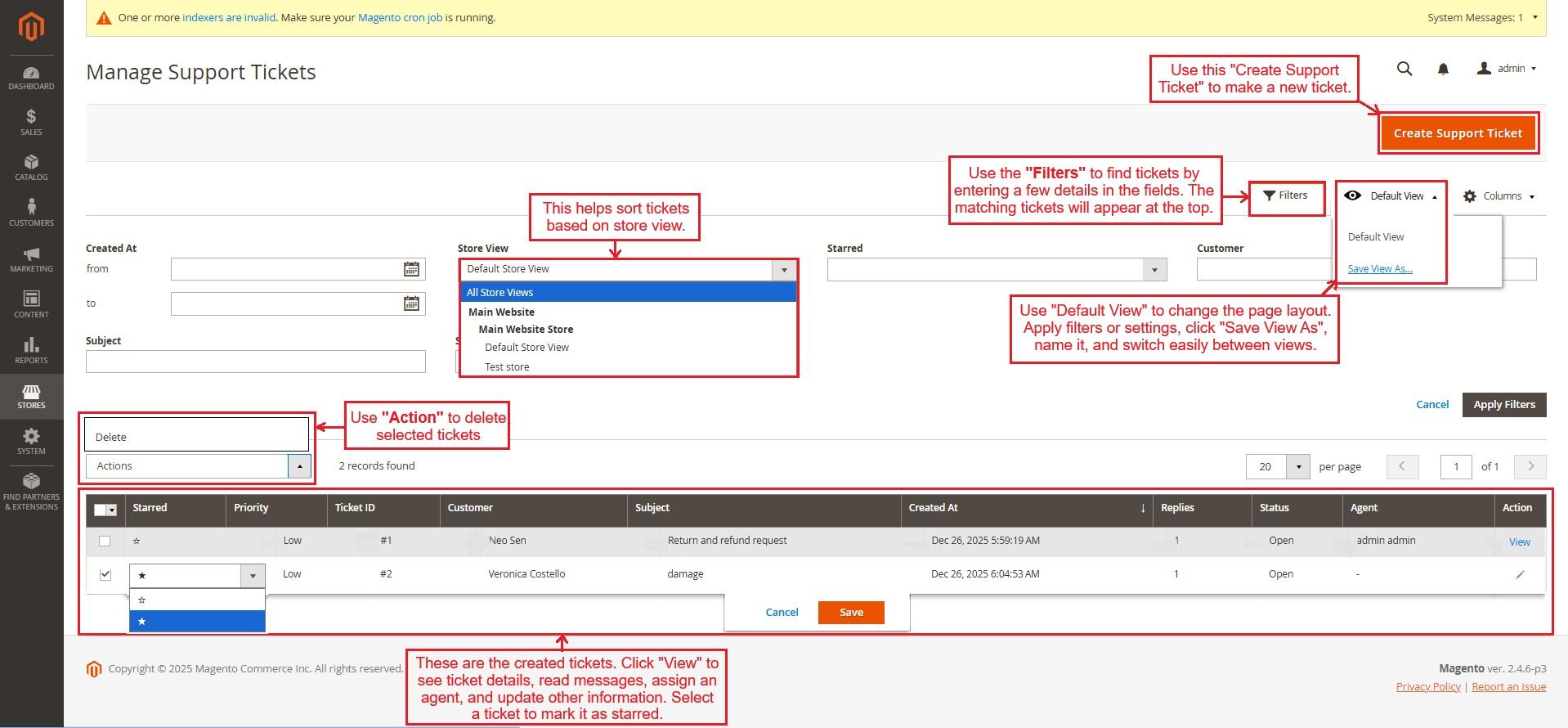
The Manage Support Tickets page helps organize and control all support requests from one place. It provides options to filter, view, and manage tickets quickly. Admins can create tickets, assign agents, customize columns, and remove tickets in just a few steps.
Use the filter option to find tickets based on status, agent, store view, subject, or customer. Select the required fields or enter details, then click “Apply Filter” to see the results.
- Ticket Status: The status dropdown includes options like Open, Pending, and Answered. Tickets move between these stages during conversations, either automatically or when updated by the admin or agents. Deleted tickets remain available in the trash and can be restored at any time.
- Starred Tickets: Mark important tickets as starred for quick access. Remove them from the list when no longer needed.
- Store View: Filter tickets based on their store view to manage multi-store setups easily.
- Column Settings: Show or hide columns based on preference. Simply uncheck options to adjust the table view.
- Delete Tickets: Select a ticket and remove it using the “Delete” option from the Actions dropdown.
Below the grid, the list of created tickets appears with key details. Click “View” to open a ticket and start a conversation. Use “Create Support Ticket” to add a new request.
Manage Ticket Type
The Ticket Types option opens the Manage Ticket Types page. Ticket types organize customer queries based on topics such as Order Shipping and Tracking, Returns and Refunds, and more. This structure helps sort, manage, and respond to queries more efficiently.
The page shows some default ticket types and provides an option to create new ones. Default types are editable but cannot be deleted.
- Edit Ticket Types: Select any existing type to update its details. Make the required changes and click Save.
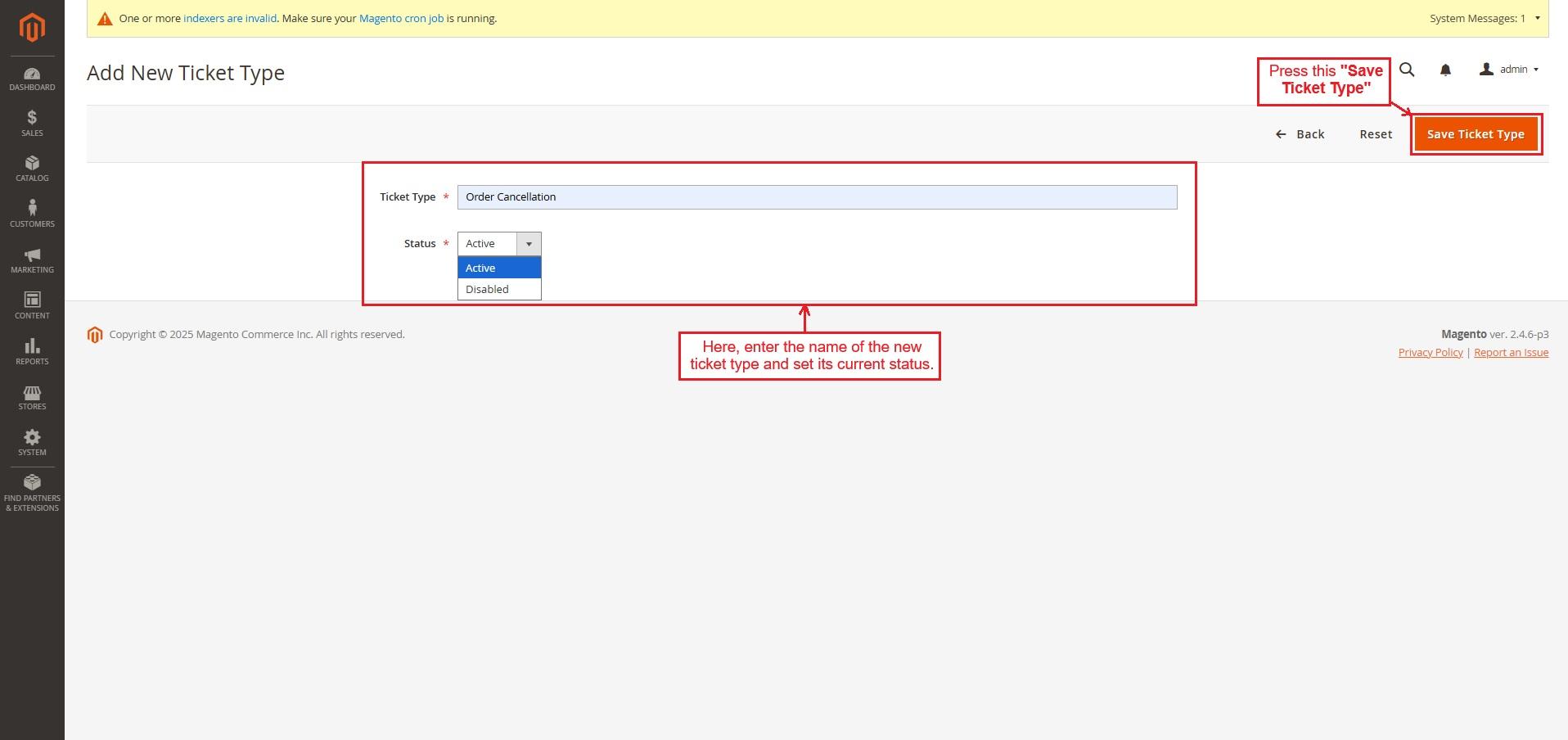
- Add New Ticket Type: Click Add New Ticket Type to create a new category. Enter the name, set the status, and click Save Ticket Type to add it.

Admin Creating New Ticket
The admin can create new tickets on behalf of customers. To do this, click the (+ Create Support Ticket) button on the Manage Support Tickets page.
Create New Ticket Process
Open the ticket creation form by using the “Create Support Ticket” button and fill-in the necessary details by following the steps below:
- Store view ➡️Select the Storeview for the ticket.
- User ➡️ Click the dropdown to choose a user/customer for the ticket, select one from the list.
- Subject ➡️ Enter the ticket subject.
- Ticket Type ➡️ Pick a ticket type from the dropdown.
- Message ➡️ Write the message in the main field.
- Attachments ➡️ And attach multiple files if required.
At the end, press the “Save Support Ticket”.


Support Tickets Dashboard and Controls
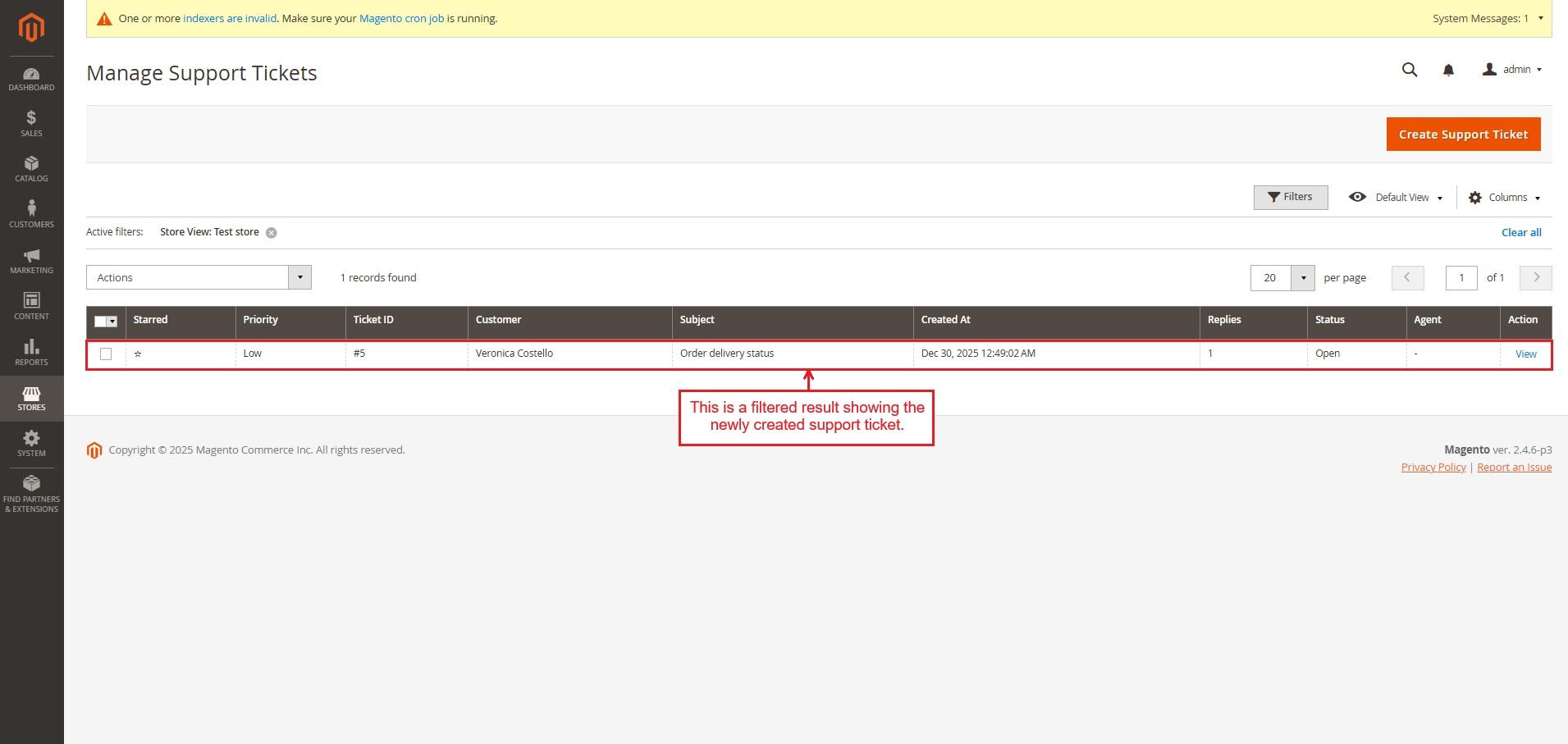
- You can find both recent and past created tickets in the Manage Support Tickets page.
- Using the filter feature, the newly created support ticket is shown.
Add User Role for Support System
To manage support tickets, the admin must create a user role. Follow these steps:
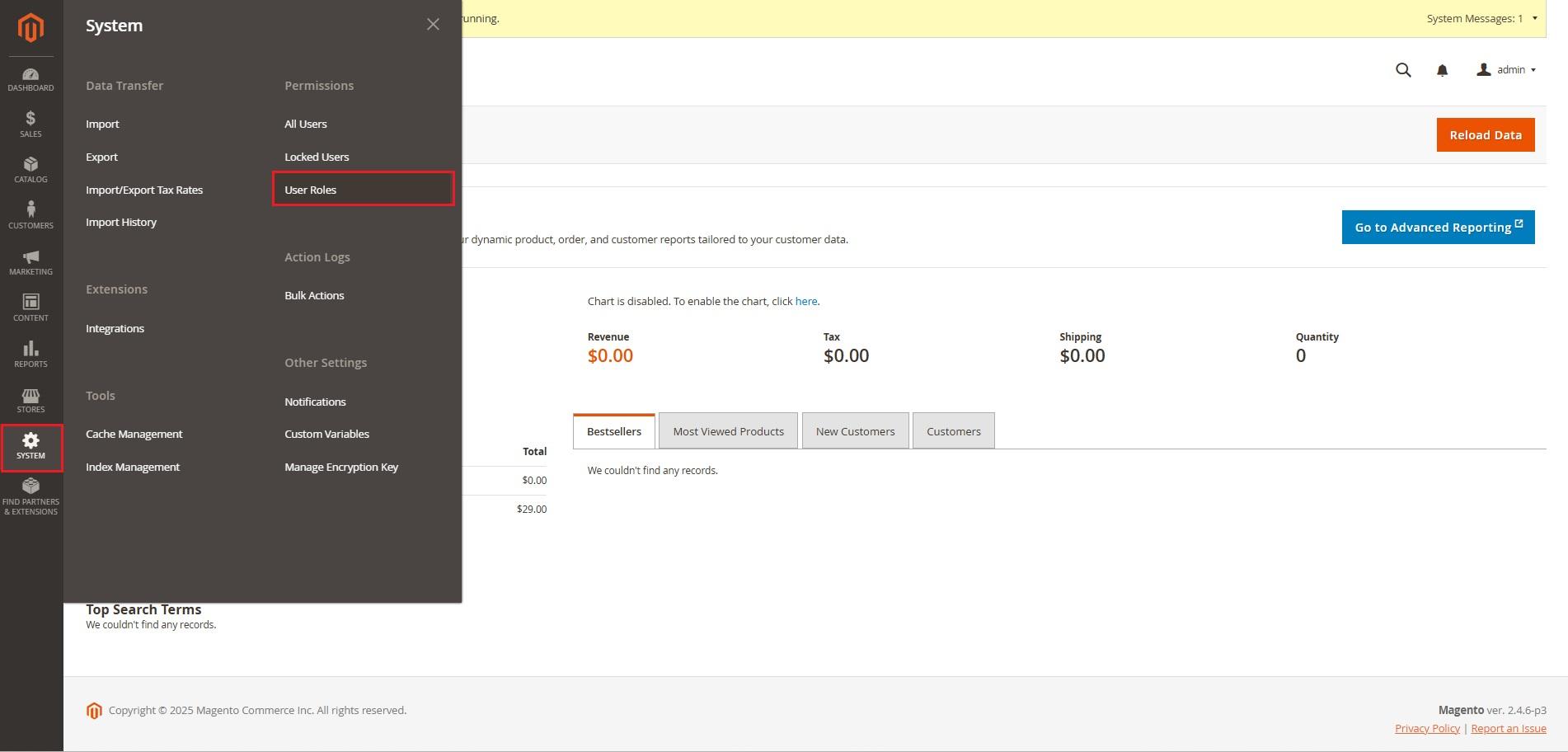
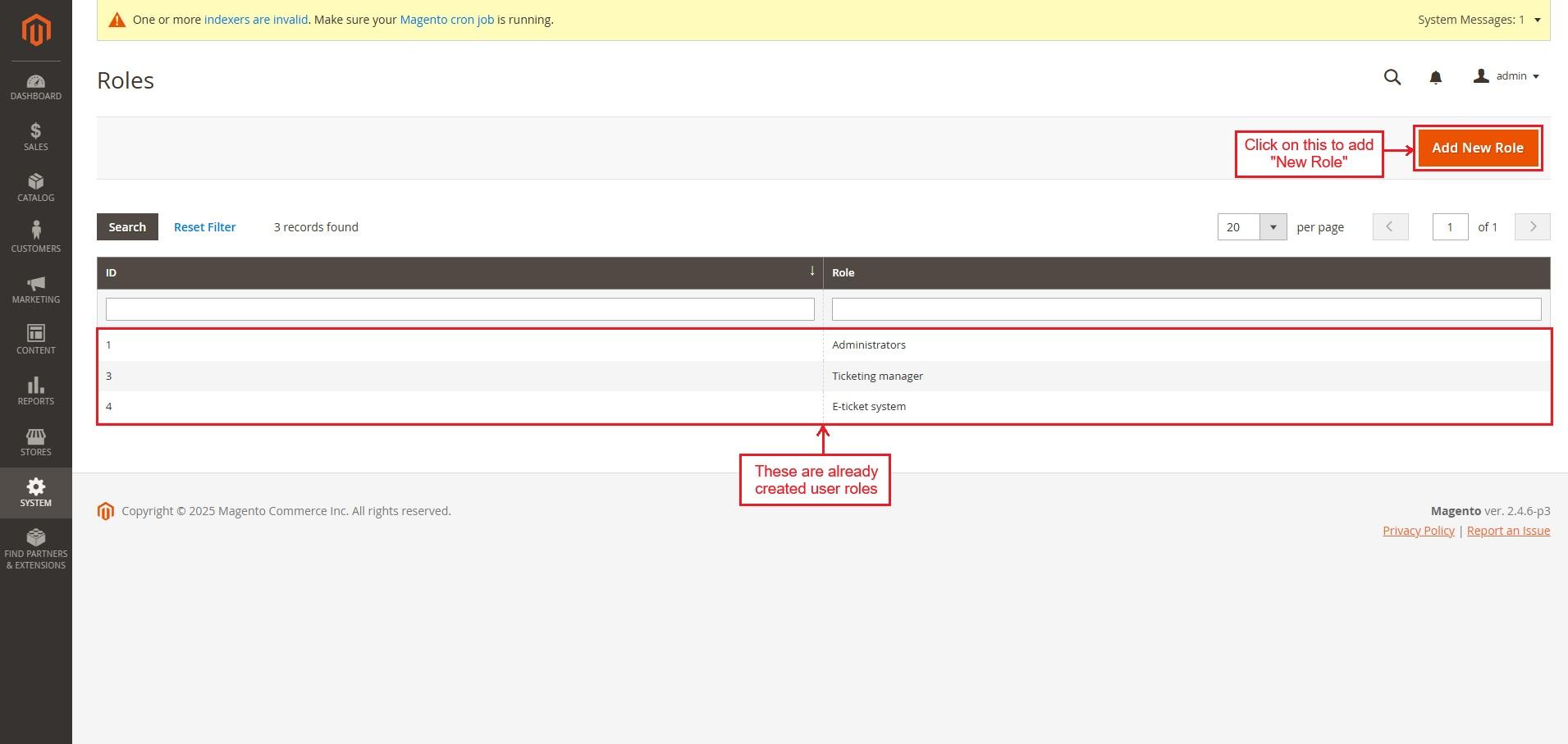
➡️Go to the System menu and select User Roles.
➡️Click on Add New Role in the top corner.
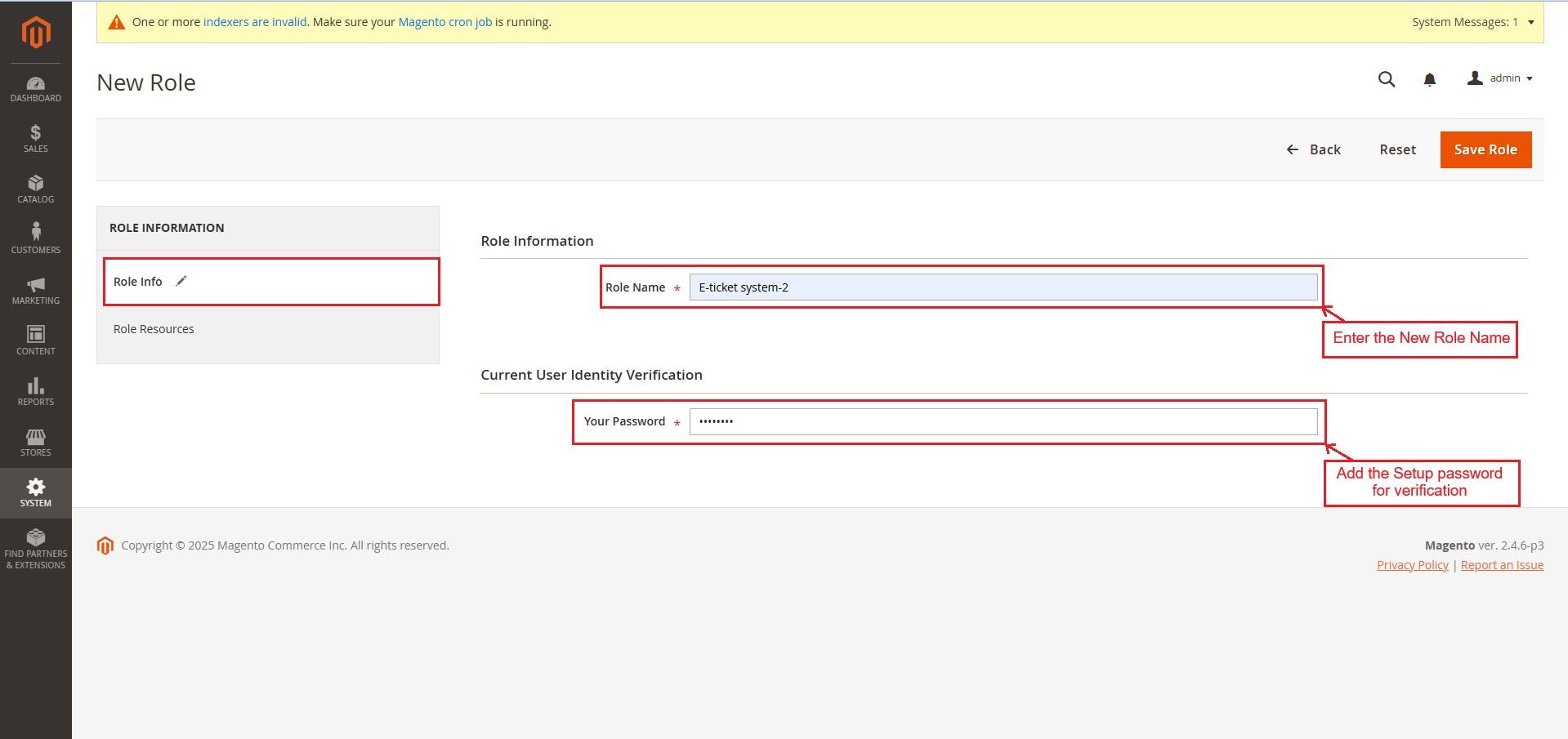
➡️In the Role Info tab, enter the name of the role.
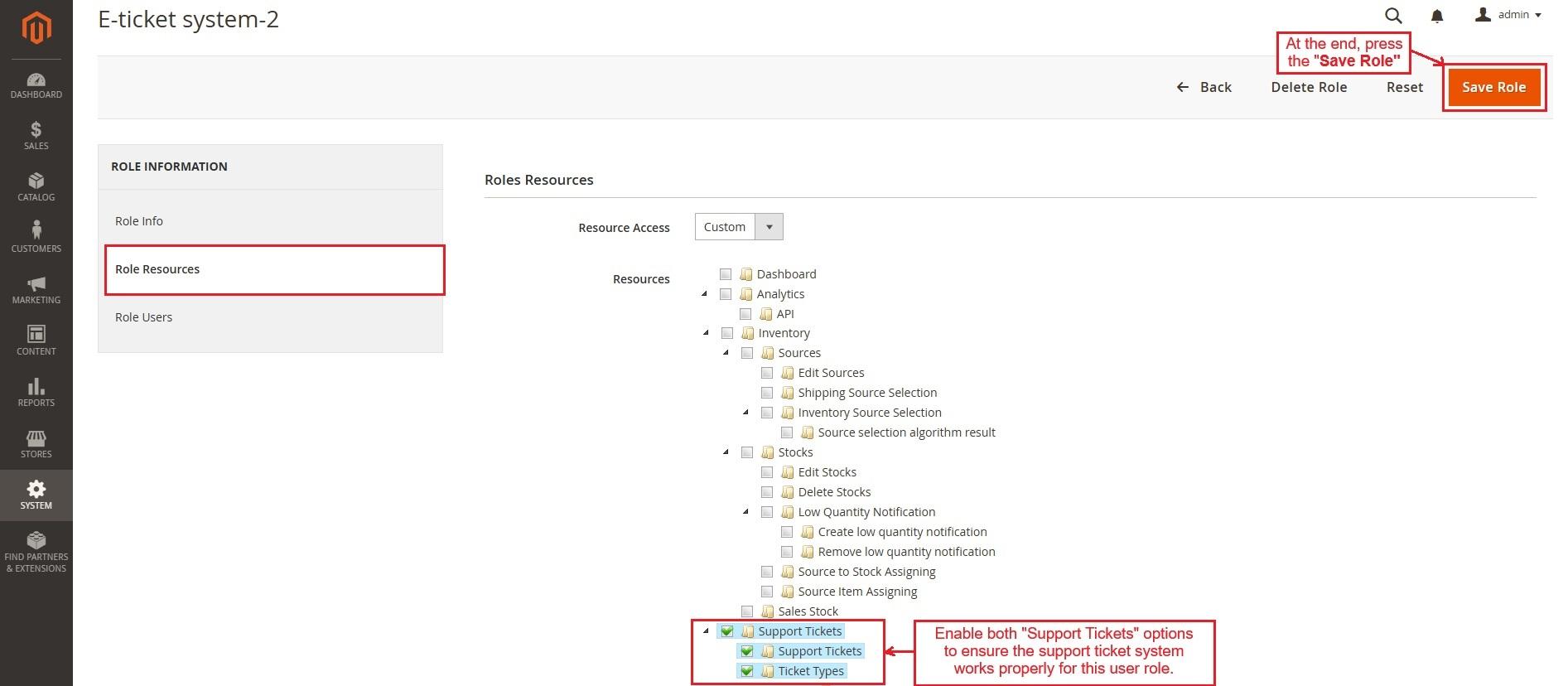
➡️Switch to the Role Resources tab and in the Reports section, enable both Support Tickets options (Support Tickets and Ticket Type) to ensure the support ticket system functions properly for this role.
➡️Finally, click Save Role to complete the setup.
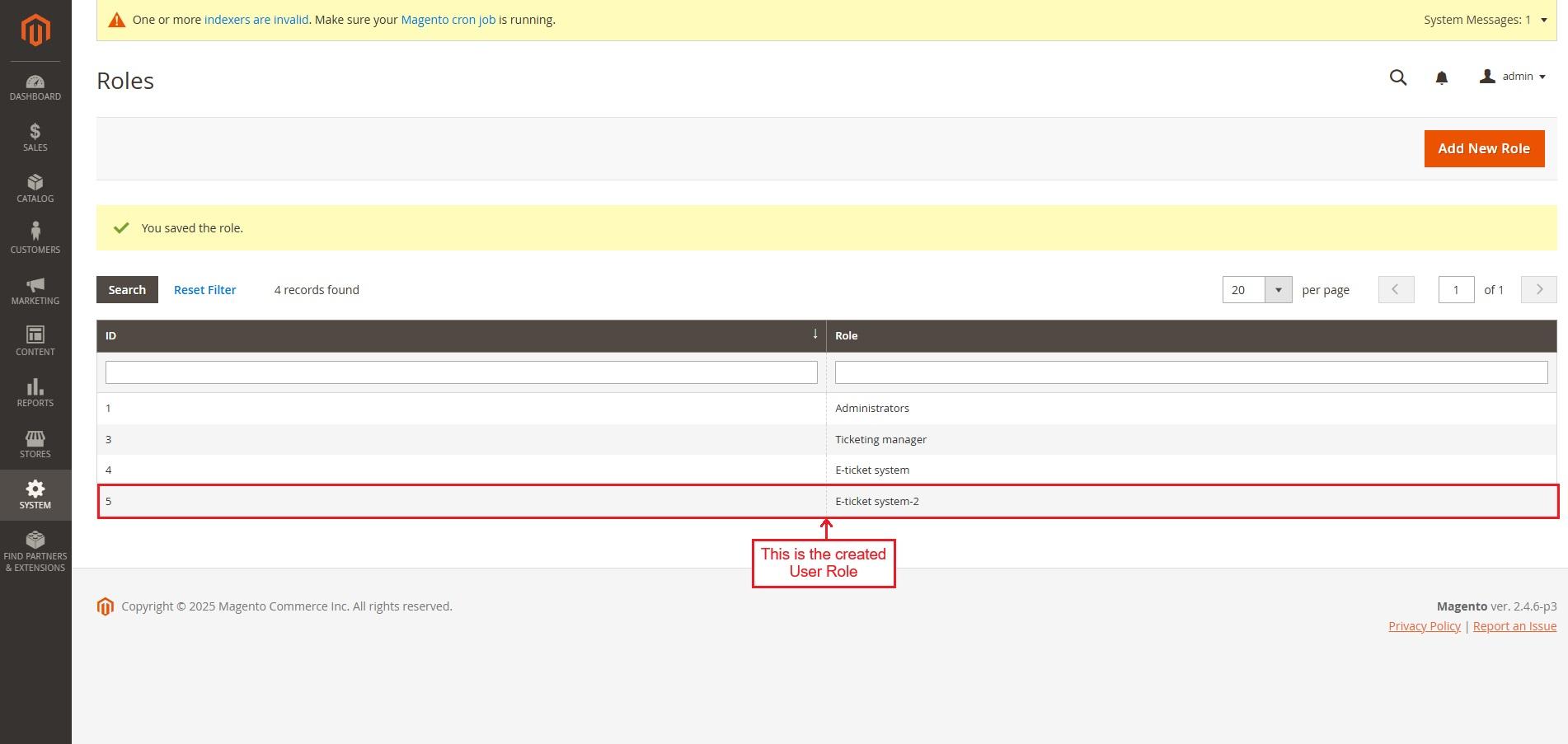
- The newly created role is now listed on this page.
- The Support Admin Usergroup must be selected in the store’s configuration settings from the available user groups/roles to manage support tickets.
- When the setting applies to a specific store view, you can assign different support admin user groups to different stores. Admin users under the selected user role are then available for agent assignment.
User Administrators Accounts
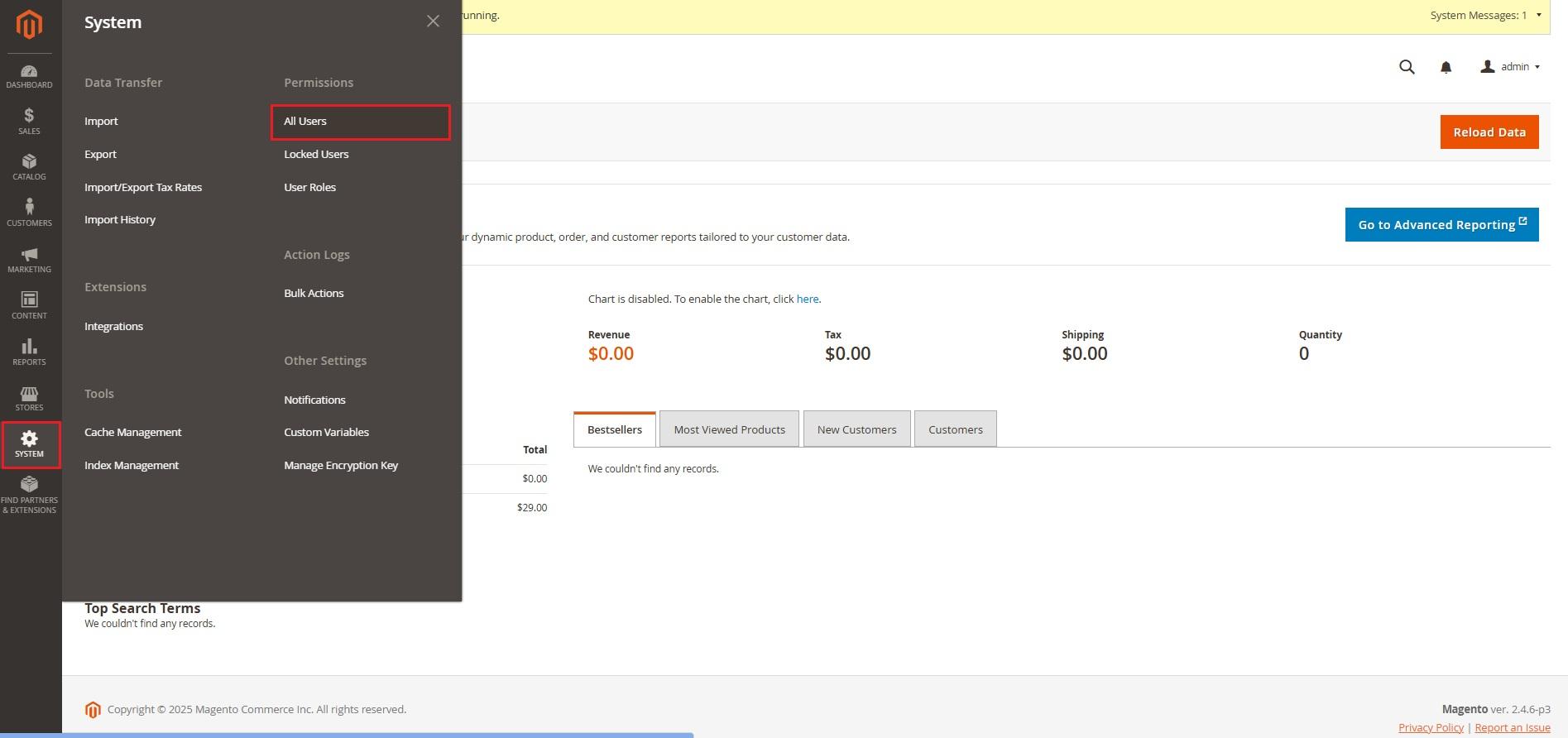
You need to create or use existing admin user accounts from the All Users section. These accounts act as agents when assigned to support tickets by the main admin.
Each account works as an agent only when the required setting is enabled. The following steps explain how to create and manage an admin user account.
- Go to the System menu and open the All Users section to view the list of admin accounts.
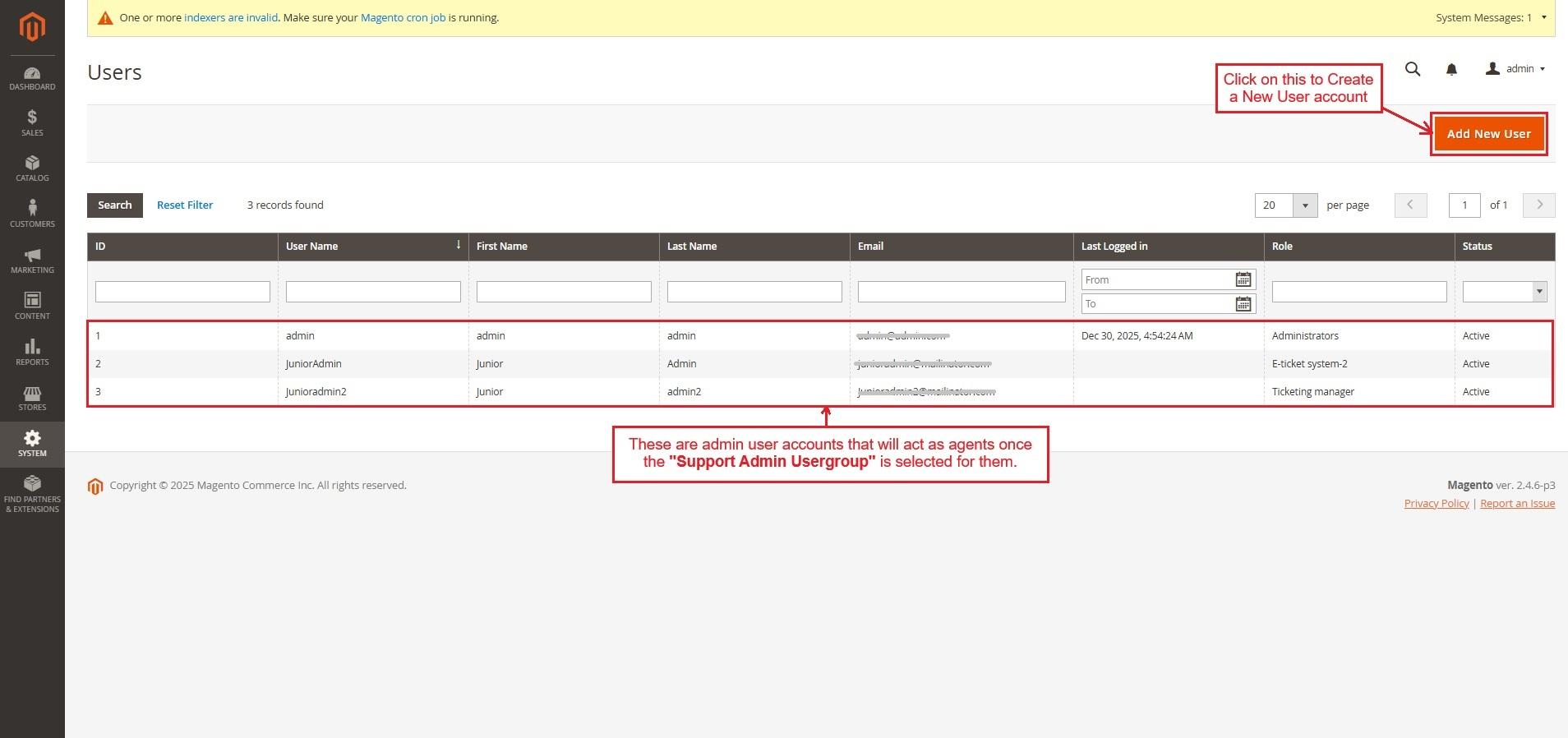
- These admin user accounts will act as agents once the selected “Support Admin User Group” is chosen for them. To proceed, let's access one existing administrator account by selecting it.
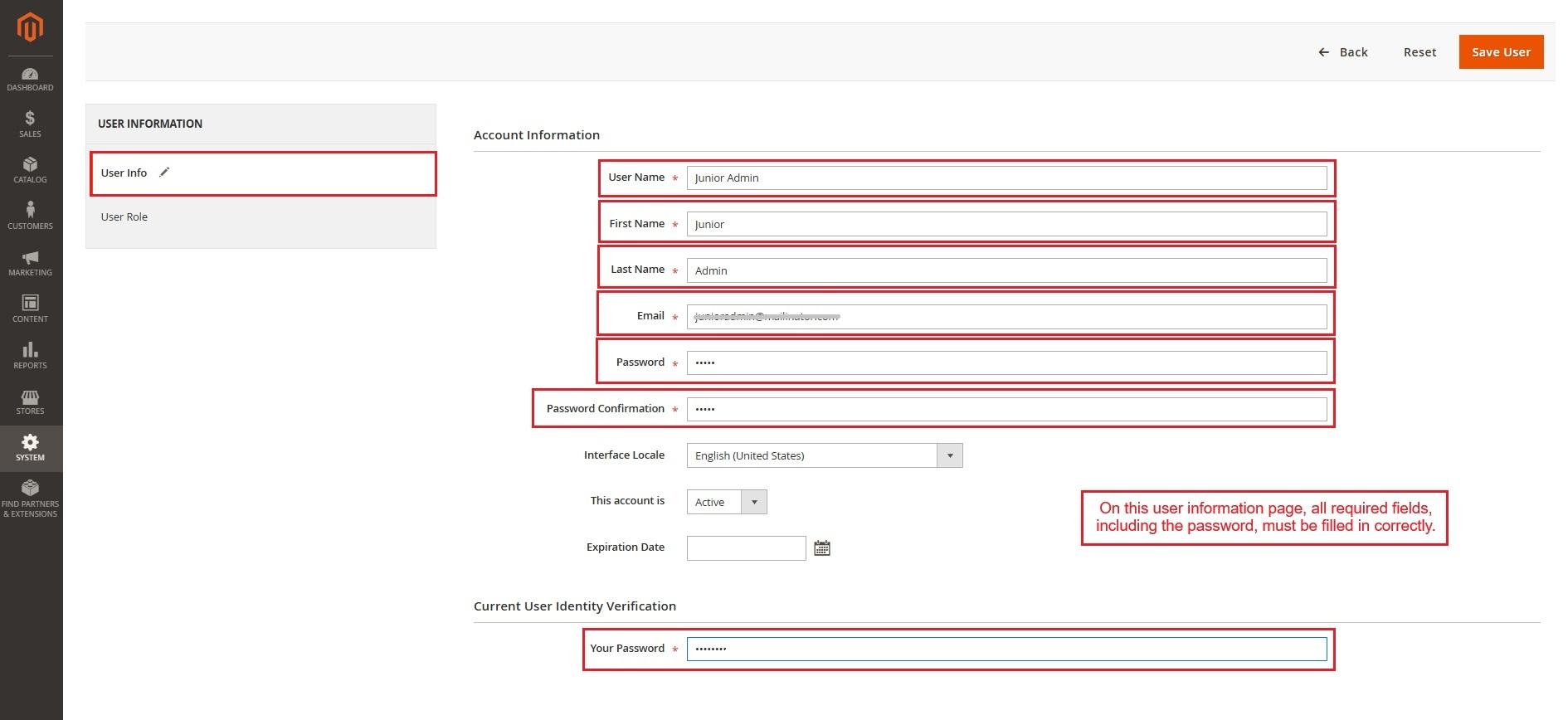
- On this User Account Information page, all required fields, including the password, must be filled in correctly.
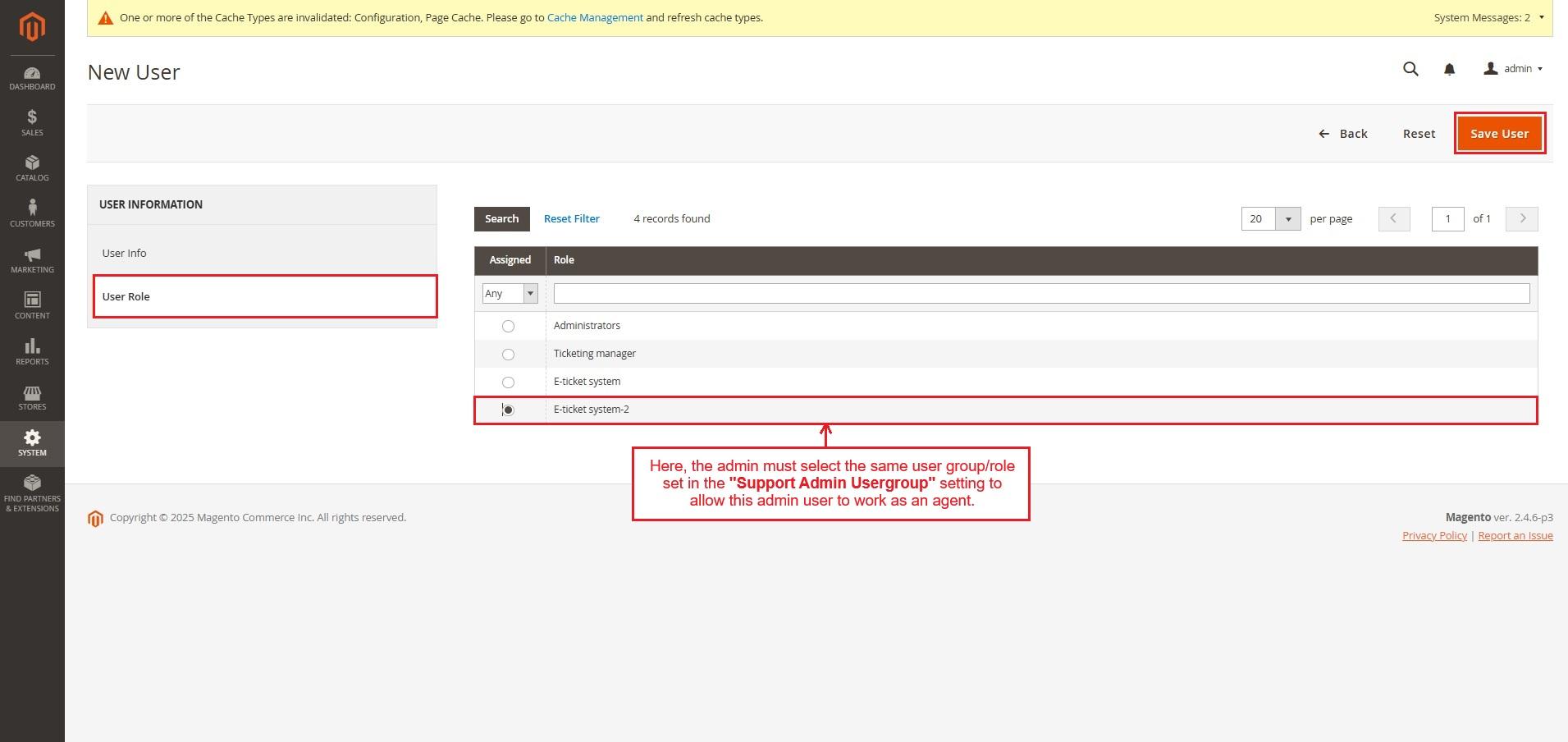
- Now, Switch to >> User Role
- Here, the admin must select the same user group/role set in the “Support Admin Usergroup” setting to allow this admin user to work as an agent.
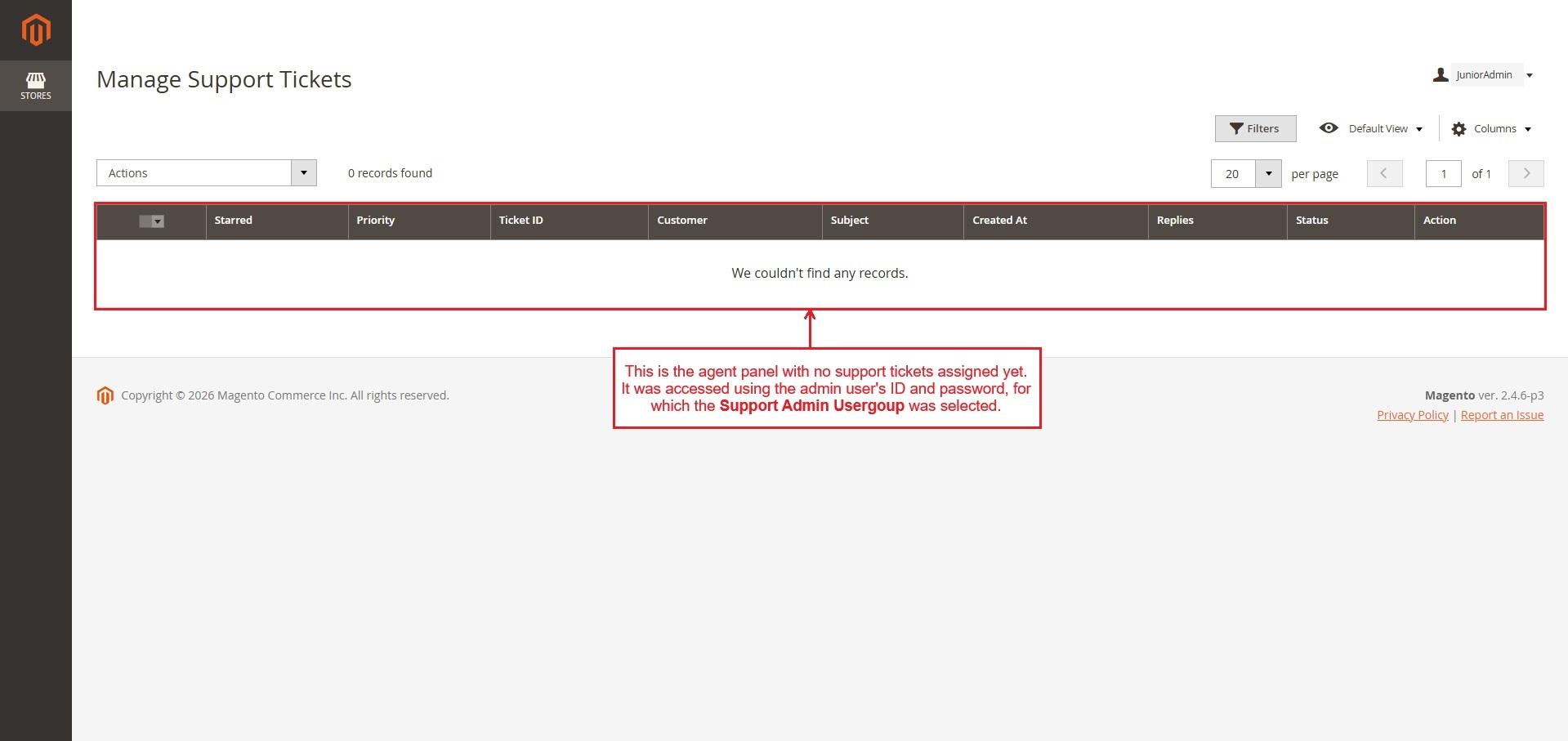
- This is the agent panel with no support ticket assigned yet. It was accessed through an admin user account for which the Support Admin Usergroup role has been selected.
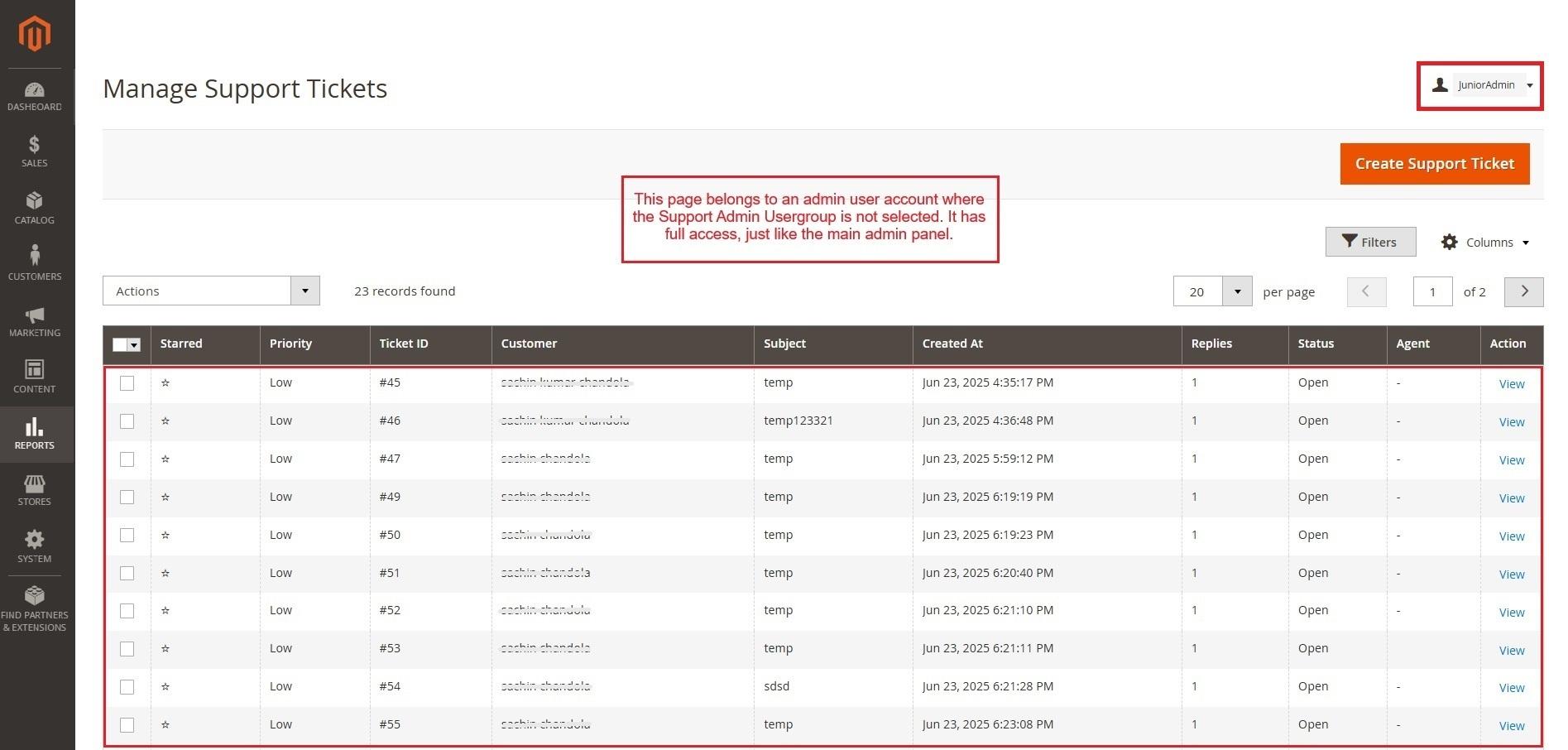
Note: If the “Support Admin Usergroup” is not selected in the admin user account profile, they will work as a regular admin. Once the admin selects it from the user role, the admin user will start working as a support agent.
How Customers Create Tickets from the Storefront
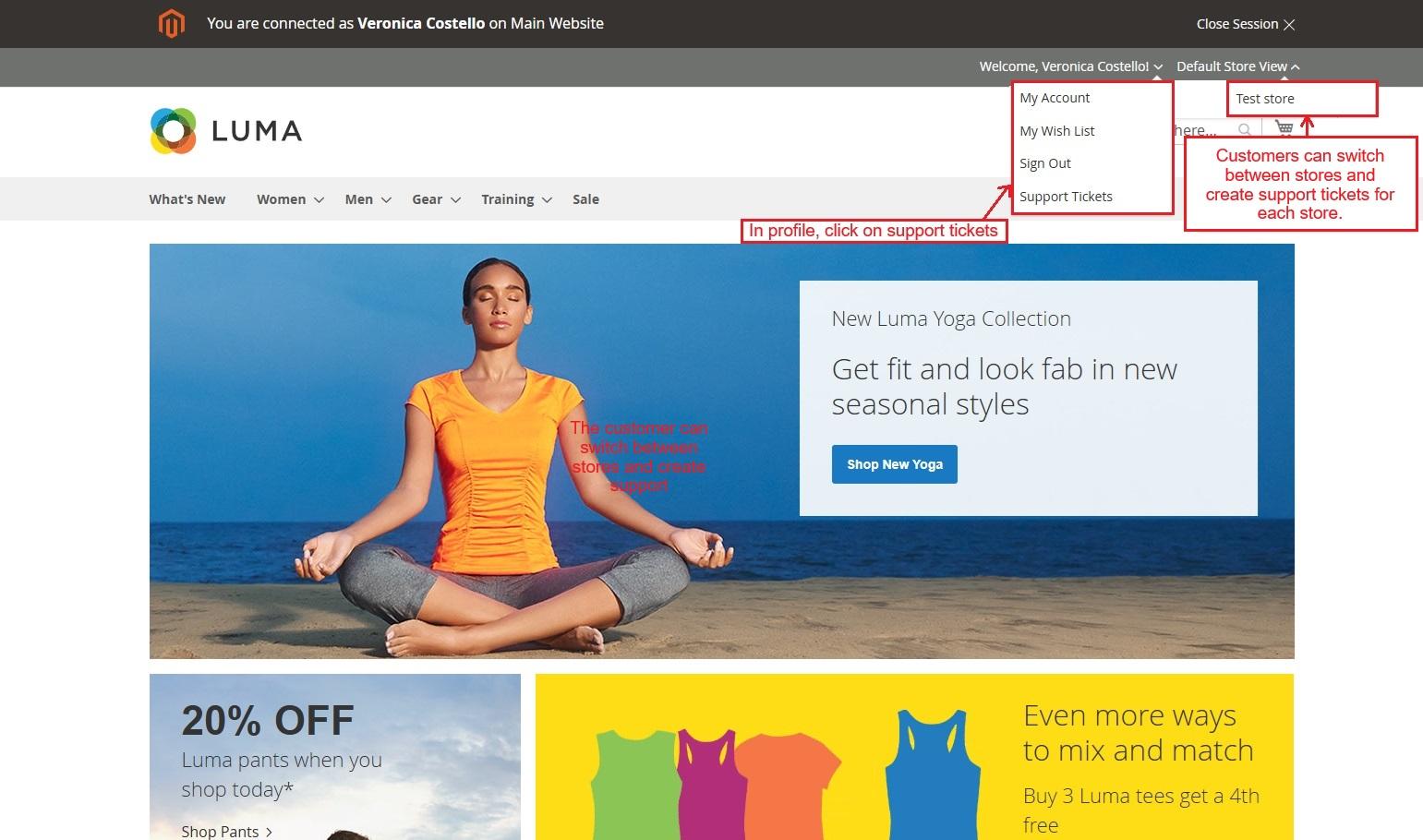
- After the customer registers successfully, the customer can switch between stores and create support tickets for each store.
- In profile, click on support tickets.
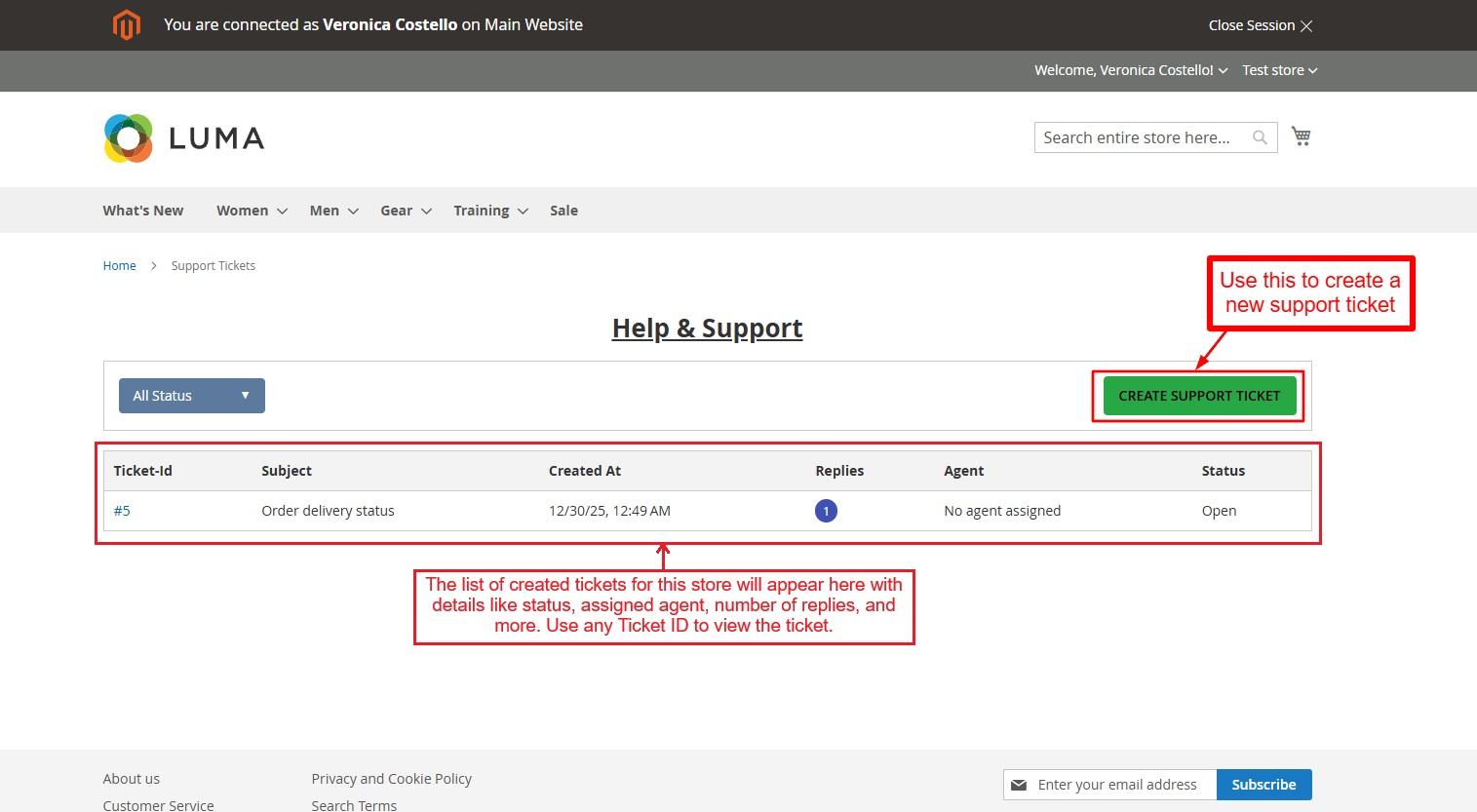
- Created tickets are listed with information such as status, agent, replies, and more. To view a ticket, use its Ticket-ID. To add a new one, click on “Create Support Ticket.”
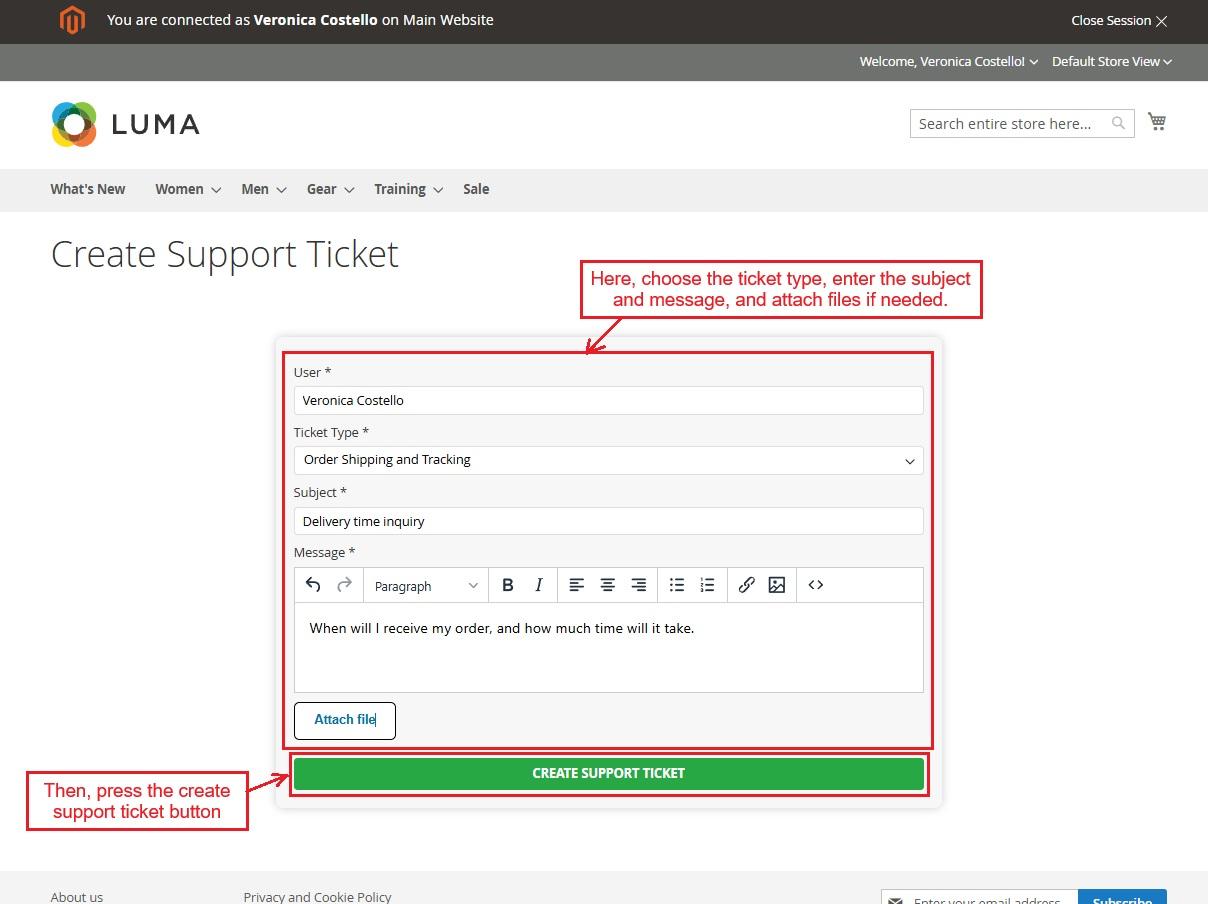
- The “Create support ticket” page allows the customer to select a ticket type, enter a subject and message, and attach a file if needed. Then, press the Create Support Ticket button.
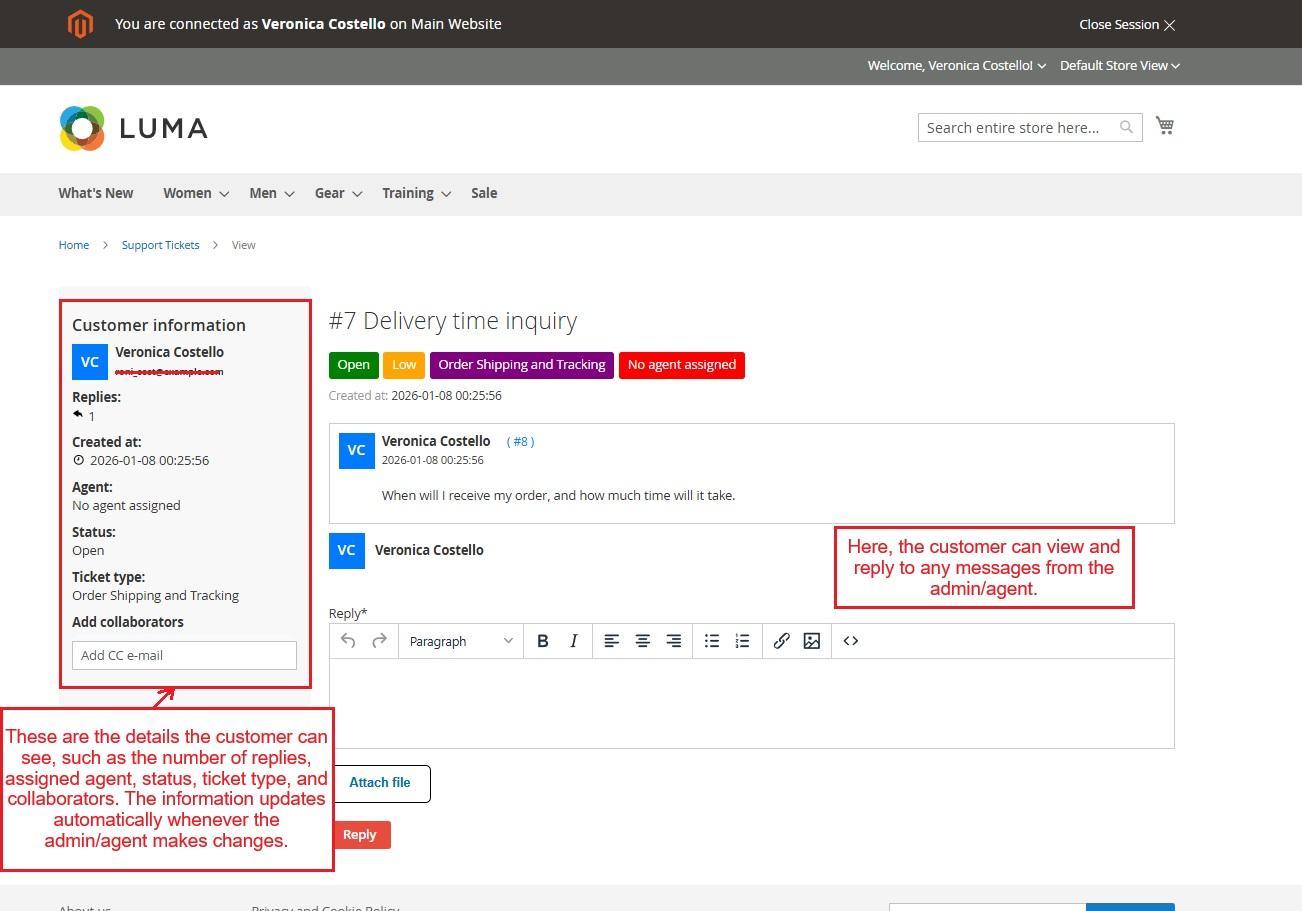
- The ticket page opens with the customer’s message and a text box to type their next message. They will also be able to reply to messages if an agent or admin sends one.
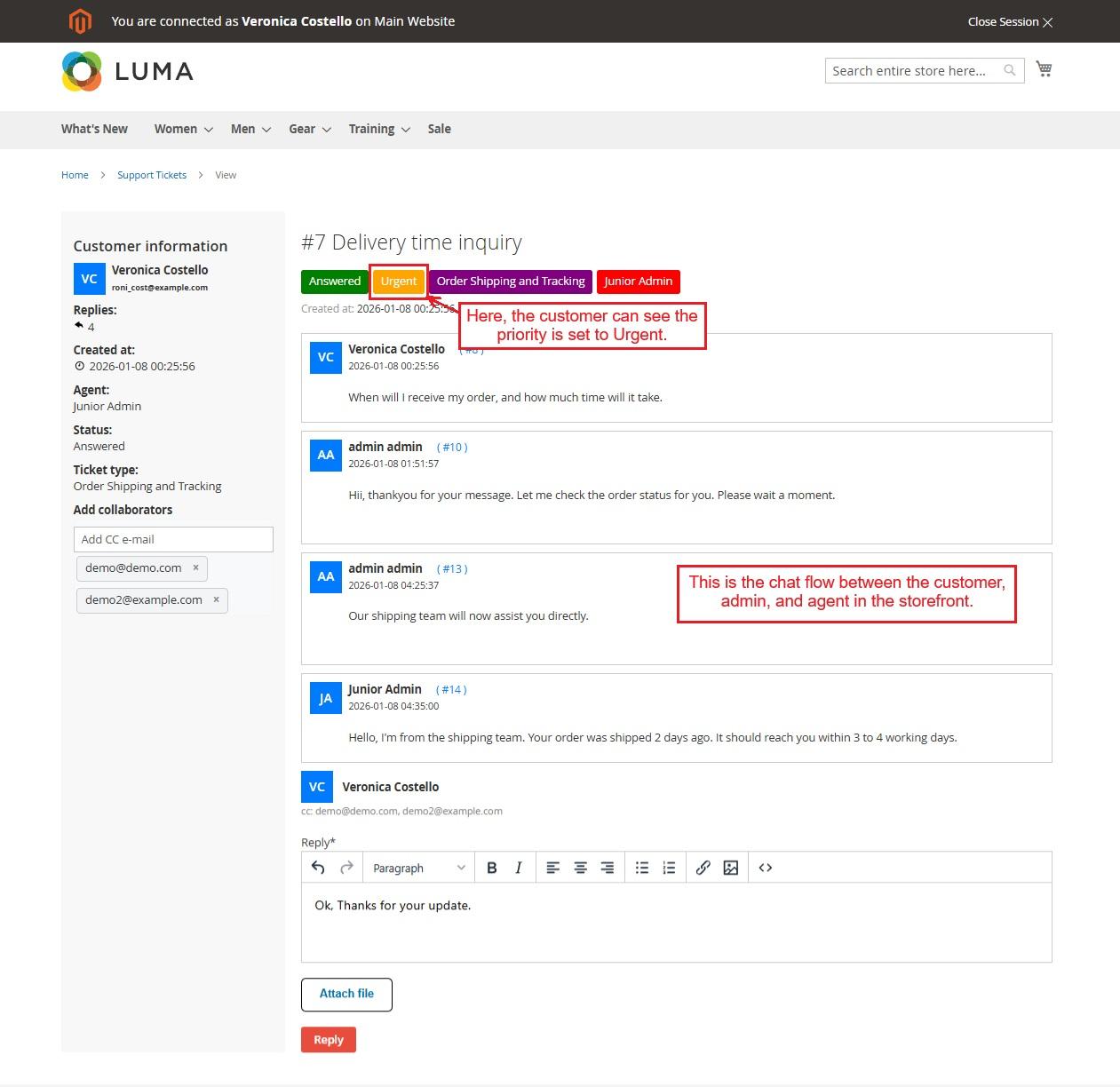
- The customer can also view ticket details like the number of replies, assigned agent, status, ticket type, and collaborators. These settings update when the admin/agent makes changes.
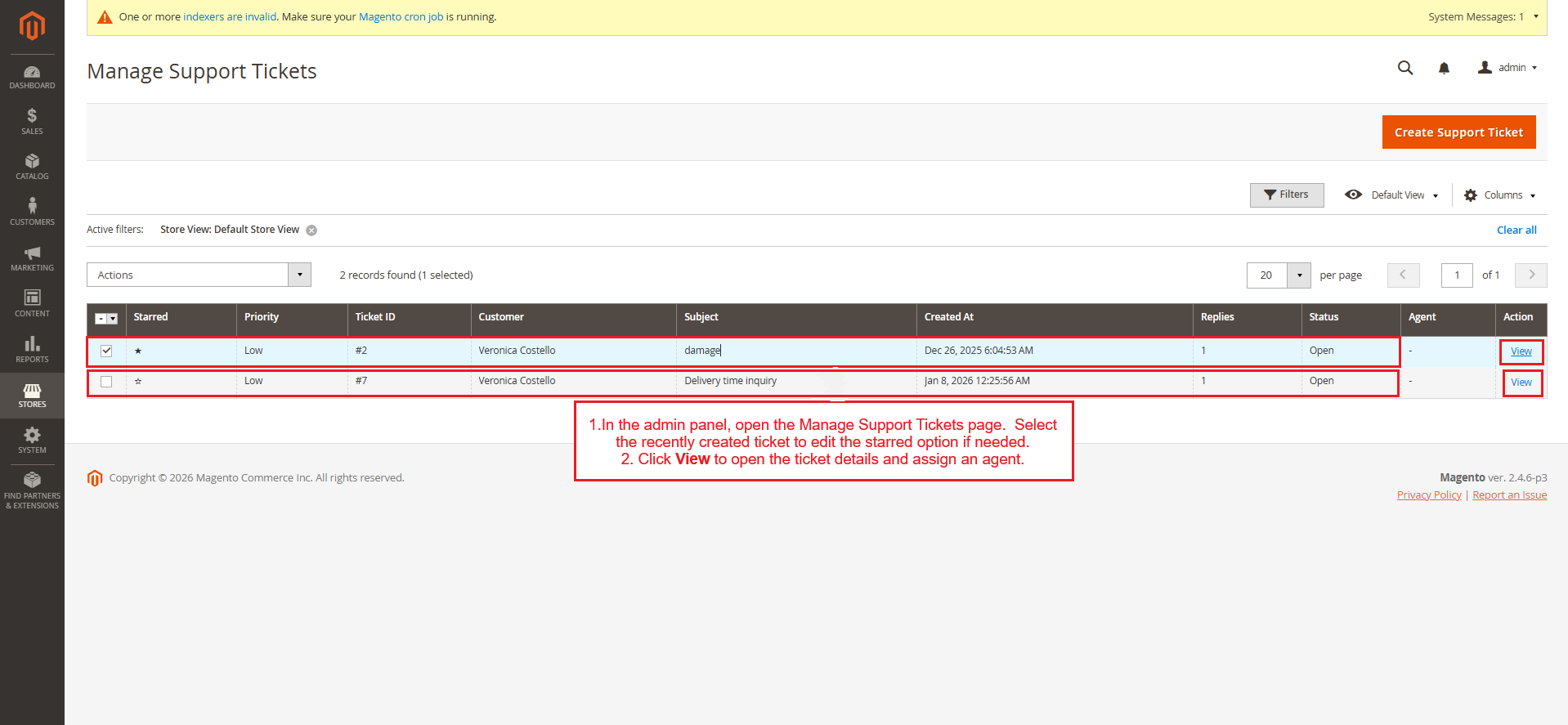
- In the admin panel, open the Manage Support Tickets page. Select the recently created ticket to edit the starred option if needed.
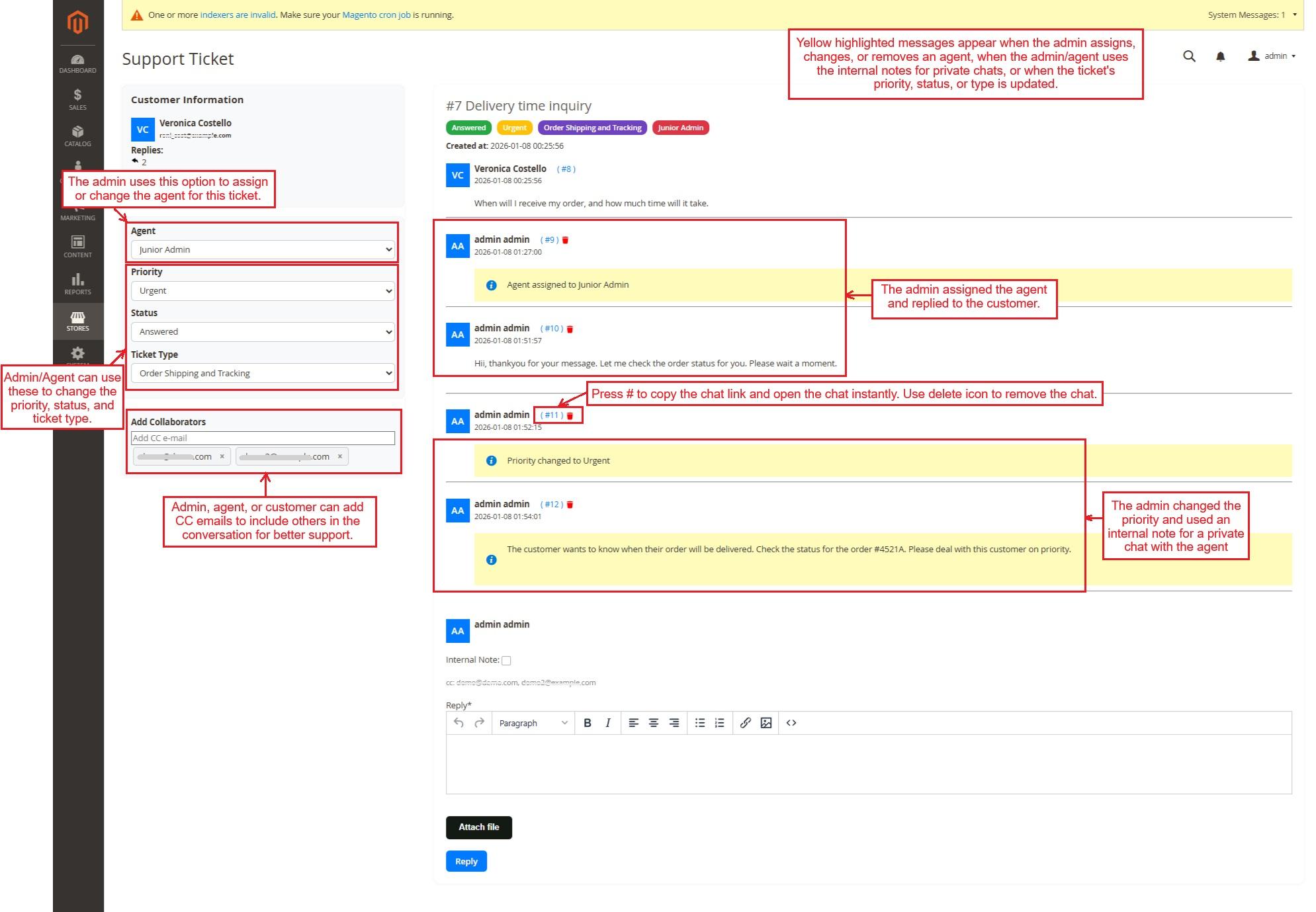
- In this case, the admin filtered the newly created ticket. Click on “View” to open the ticket and assign an agent.
- The admin uses the Agent option to assign or change the agent for the ticket.
- Here, “Junior Admin” is selected as an agent and admin replied to customer.
- The admin also changed the ticket priority and used the Internal note feature for a private chat with the agent. Internal notes are only for internal discussions and are not visible to the customer.
- Yellow-highlighted messages appear when the admin assigns, changes, or removes an agent; when internal notes are used for private chats by the admin or agent; or when the ticket’s priority, status, or type is updated.
- Press # to copy the chat link and open that chat instantly and use delete icon to remove the chat
In the Admin, Agent, and Customer panels, the Support Ticket chats page allows the following actions:
- Only in Admin Panel: The admin can reassign the ticket to another agent.
- Admin and Agent Panels: Both can change the ticket’s priority, status, and type in their chats page.
- Admin, Agent, and Customer Panels: All three can add CC emails to include others in the conversation for better support.
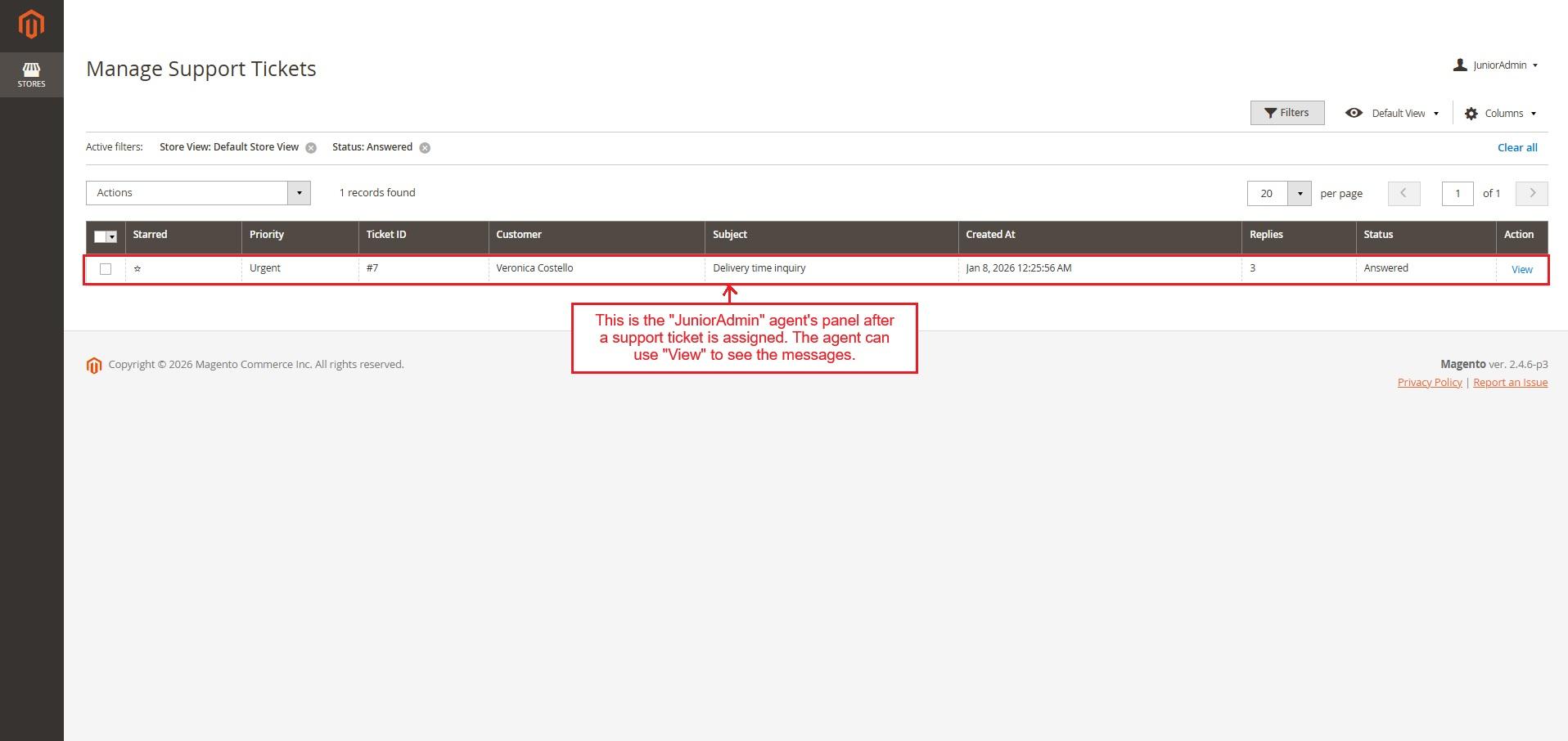
Assigned Ticket in Agent Panel
The ticket is visible in the panel of the assigned agent. They can click on the Ticket ID or Replies to view the messages.
- Below you can see the customer’s ticket priority is set to High and the chat flow between the customer, admin, and agent.
Email Notification
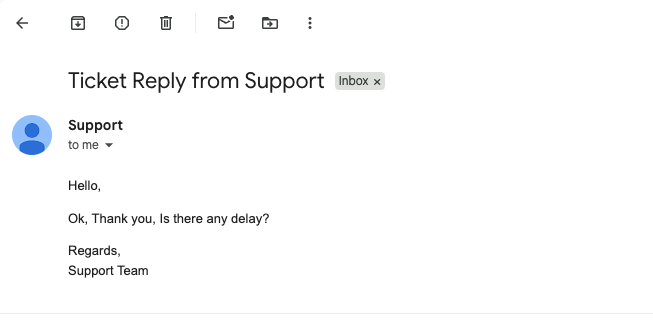
The admin, agent, and customer get email notifications for some ticket-related updates. For example, the admin is notified when a ticket is created, the customer gets an email when the agent replies, and more notifications are sent in similar cases.
These are email notifications of different cases:
- Customer received mail when agent replied
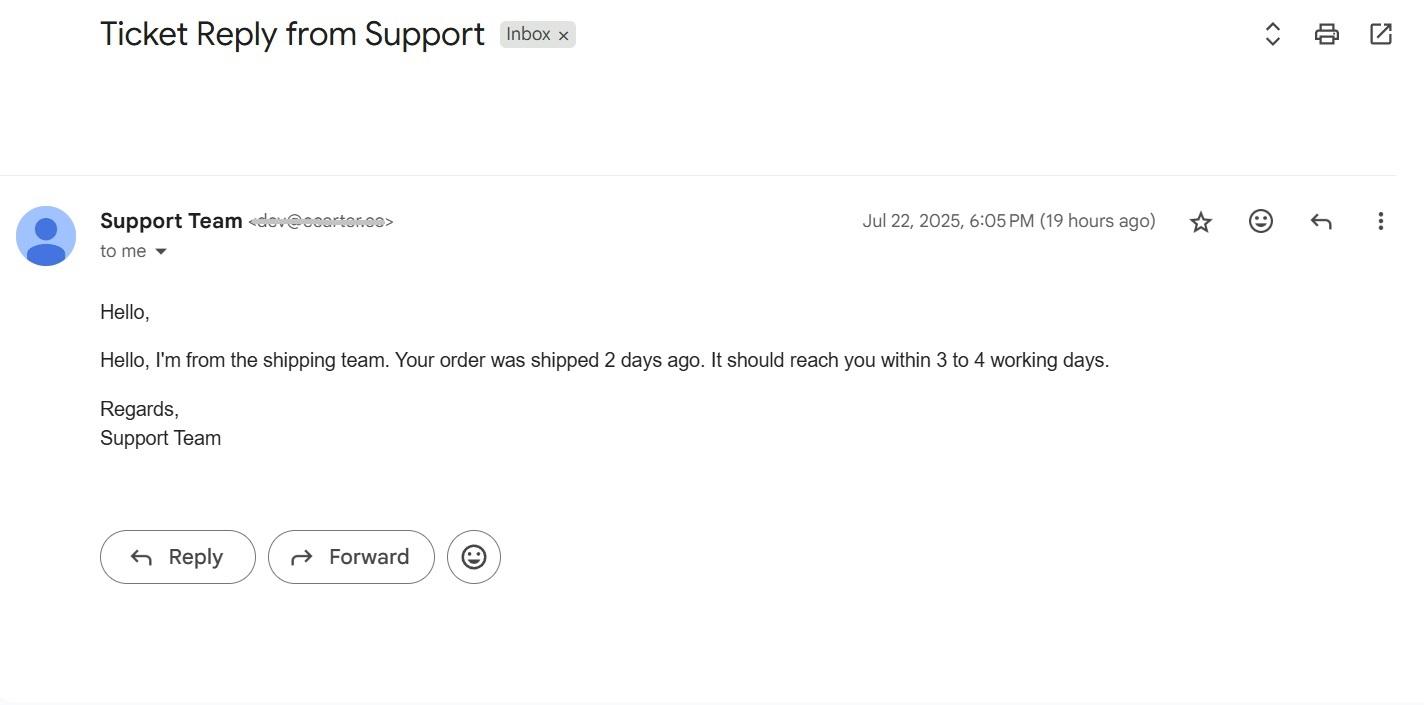
- Agent received mail when customer replied
✅ Final Thought
The Support Ticket System extension for Magento keeps customer support simple and well-organized. It brings admins, agents, and customers onto one clear platform with role-based access, store-wise settings, and ready email templates. Tickets stay easy to track with filters, priorities, internal notes, and agent assignment. Customers get quick updates through emails and a clean storefront panel. This setup improves response time, reduces confusion, and helps teams manage support smoothly across multiple stores.
Supported Framework Version - 2.0.x, 2.1.x, 2.2.x,2.3.x, 2.4.x
Support:
This module is developed and published by Ecarter Technologies Pvt.Ltd., a Magento developer. You are guaranteed a quality module supported by future versions. If you need help, please contact us via email at support@ecarter.co.




Ecarter Support
Typically replies within a minute

© 2020 - 2026 Ecarter Technologies Pvt Ltd.